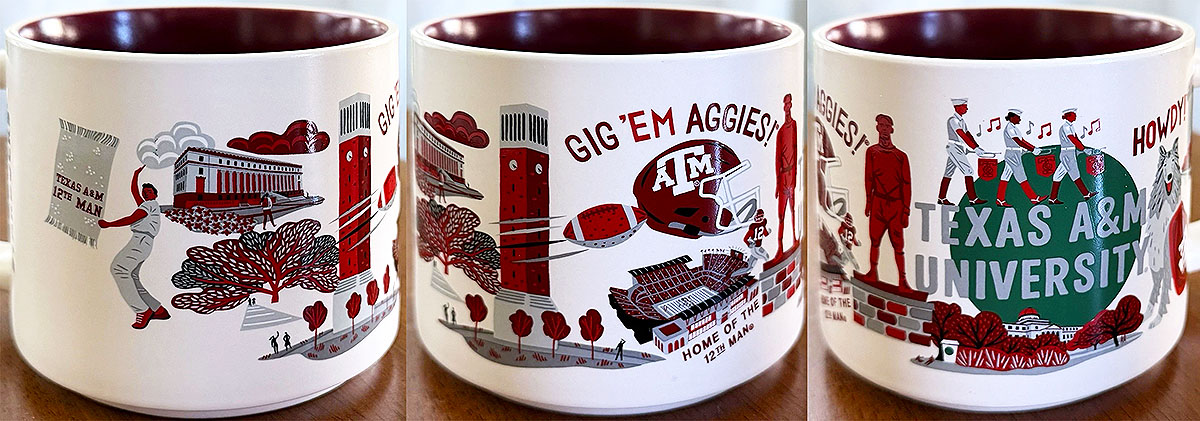

Discovery Series – Texas A&M University


Discovery Series – Texas A&M is a mug for a university, founded in 1876 as the Agricultural and Mechanical College of Texas, the state’s first public institution of higher learning. It was originally an all-male military school and part of the Morrill Act system that established land-grant universities across the nation. Over the years, it evolved into one of the largest and most respected universities in the United States. Its traditions, loyalty, and sense of community have remained deeply rooted in its agricultural and military beginnings. Today, Texas A&M stands as a symbol of leadership, service, and Aggie pride.
– The Albritton Bell Tower stands as one of the most visible symbols on campus. Completed in 1984, it was named after Richard Albritton, whose family donated funds for its construction. The tower’s chimes ring across campus, marking time and significant moments such as Silver Taps and Muster ceremonies. It serves not only as a landmark but also as a reminder of the values of reflection, honor, and remembrance that define Aggie life.
– The Academic Building is one of the oldest and most recognized structures at Texas A&M. Built in 1914 after the original Main Building burned down, it houses classrooms and offices while standing as a symbol of academic excellence. Its copper dome and classical design have made it a favorite gathering place and a visual anchor of the campus.
– The statue of Lawrence Sullivan “Sul” Ross, located in front of the Academic Building, honors one of the most influential figures in Texas A&M’s early history. Ross served as the 19th governor of Texas and later as president of the university from 1891 to 1898. His leadership transformed the struggling college into a respected institution with a strong academic foundation. For generations, students have left pennies at his statue before exams as a sign of respect and hope for good luck – a gesture that continues to connect current Aggies to their predecessors.
– The Texas A&M Aggies represent not just a sports program but a deeply ingrained identity. The term “Aggie” comes from the school’s agricultural roots and now embodies the spirit of teamwork, perseverance, and unity. Whether in athletics, academics, or service, Aggies carry a shared sense of belonging and pride. The university competes in the Southeastern Conference (SEC) and has built rivalries that fuel passion across the Aggie community. Every game, event, and tradition celebrates a heritage that transcends generations.
– The story of the 12th Man is one of the most powerful traditions in college sports. It began in 1922 when student E. King Gill stood ready to play for an injured Texas A&M football team during the Dixie Classic. Though he never entered the game, his willingness to stand by his team became a symbol of selfless support. Today, the entire student section at Kyle Field stands throughout football games, representing the 12th Man’s readiness, loyalty, and unity. It’s a living example of what it means to serve and support others – core values of every Aggie.
– Texas A&M’s mascot, Reveille, is more than a dog – she’s the “First Lady of Aggieland.” The tradition began in 1931 when cadets rescued a dog hit by a car and named her Reveille. Today, Reveille is a Rough Collie cared for by a sophomore cadet from Company E-2 of the Corps of Cadets. She attends classes, football games, and official events, serving as a living symbol of loyalty and tradition.
– The Fightin’ Texas Aggie Band is the largest military marching band in the United States. Known for its precision drills and powerful performances, the band performs at every home football game and major university event. Its roots trace back to 1894, reflecting Texas A&M’s strong military heritage. The band’s complex formations and synchronized movements make it a source of immense pride and national recognition.
– Kyle Field is the home of the Aggie football team and the heart of Aggie spirit. First built in 1904 and expanded many times since, it is now one of the largest stadiums in the country, seating over 100,000 fans. On game days, the stands shake with coordinated yells, the sound of the Aggie Band, and the energy of the 12th Man. It’s more than a field – it’s a living symbol of unity and school pride.
– The phrase “Gig ’Em Aggies!” originated in 1930 when Pinky Downs, a member of the A&M Board of Regents, shouted it at a pep rally before a football game against TCU. The term “Gig ’Em” refers to a frog-hunting tool, a playful jab at TCU’s Horned Frog mascot. It became the university’s first hand sign and one of its most enduring traditions. The thumbs-up gesture and phrase now express encouragement, approval, and Aggie camaraderie.
– The Corps of Cadets remains at the core of Texas A&M’s identity. As the oldest student organization on campus, it has been developing leaders since the university’s founding. While military service is no longer mandatory, the Corps preserves A&M’s discipline, honor, and leadership training. Its members participate in countless traditions, parades, and service projects, linking the modern university to its historic foundation as a military school.