Discovery Series – Philippines


The Starbucks Discovery Series Philippines mug explores the history, traditions, food, and landscapes of this Southeast Asian archipelago. Spanish colonial rule began in the 16th century, with Manila becoming the colonial capital in 1571. Following the Philippine Revolution, independence from Spain was proclaimed on June 12, 1898, although the islands subsequently came under American rule. The Philippines finally gained full sovereignty in 1946, and today its culture reflects centuries of indigenous traditions combined with Spanish, Asian, and American influences.
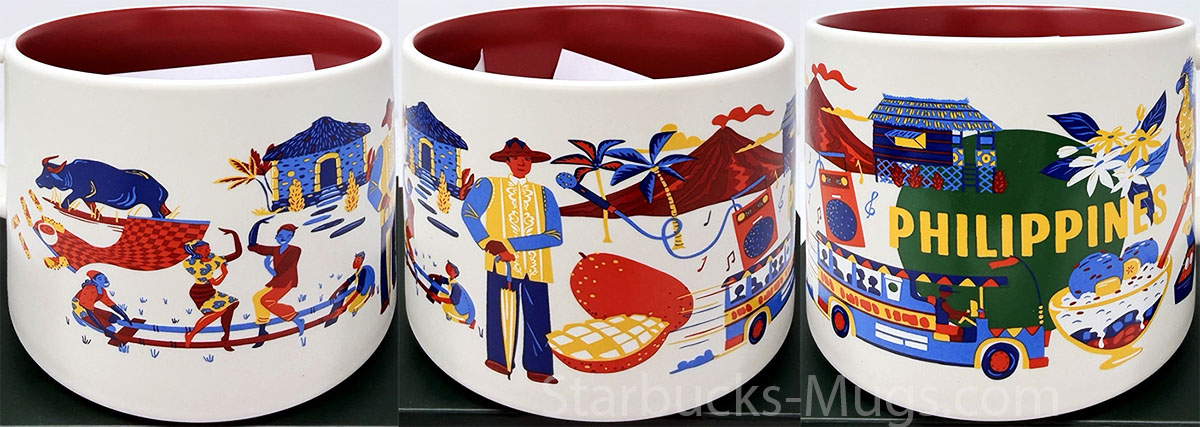
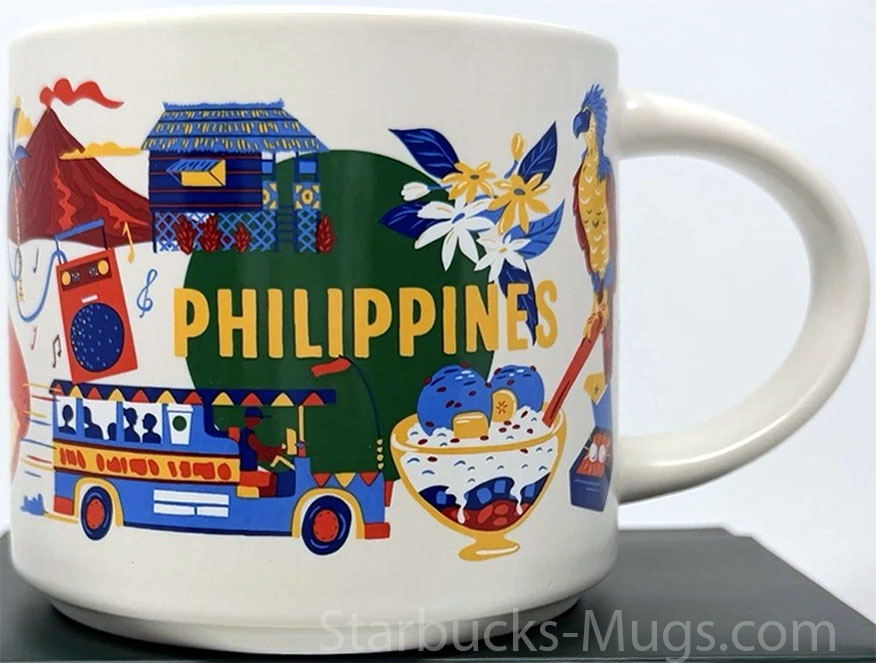
– The jeepney immediately stands out on the front of the mug. These colorful vehicles developed from American military jeeps left in the Philippines after World War II, which Filipinos modified to carry passengers. Famous for their elaborate decorations, bright colors, and individually customized appearance, jeepneys became an unmistakable part of everyday transportation and Filipino culture.
– The white flowers above the country name are sampaguita (Jasminum sambac), the national flower of the Philippines. The small, intensely fragrant flowers are commonly made into garlands and can often be seen being offered at churches, religious shrines, and other important locations. Their simple white appearance is traditionally associated with purity and humility.
– The dessert on the front is halo-halo, one of the Philippines’ favorite ways to cool down in the tropical heat. Its name means “mix-mix,” which describes exactly how it is eaten: shaved ice is combined with evaporated milk and a colorful assortment of ingredients such as sweetened beans, coconut, fruit, jellies, and ube. A scoop of ice cream is also commonly added on top.
– The traditional fishing village house reflects the coastal communities found throughout the Philippine archipelago. In many fishing villages, homes are built close to the water and are often raised on stilts to protect them from tides and flooding. Traditionally constructed from locally available materials such as wood, bamboo, and nipa palm, these simple houses are closely connected to the fishing communities that have depended on the surrounding seas for generations.
– Moving toward the side of the mug, the towering Mayon Volcano is recognizable by its remarkably symmetrical cone. Located in Albay on the island of Luzon, Mayon rises to about 8,077 feet (2,462 meters) and is also one of the country’s most active volcanoes. Its almost perfectly shaped profile has made it one of the Philippines’ most recognizable natural landmarks.
– The man wearing the embroidered formal shirt is dressed in a Barong Tagalog. Traditionally made from lightweight, often translucent fabric and worn untucked, the barong is an important form of Filipino formal attire. Elaborately embroidered versions are commonly worn at weddings, official ceremonies, and other special occasions.
– The large fruit beside him is a mango, one of the foods most strongly associated with the Philippines. Philippine mangoes are particularly famous for their sweetness, with the Carabao mango being the country’s best-known variety. They are eaten fresh and also turned into juices, desserts, preserves, and the popular dried mango found in shops throughout the country.
– The carabao, or water buffalo, has played an important role in Philippine agriculture for generations. Traditionally used to plow rice fields and transport heavy loads, the animal became closely associated with rural life and Filipino farming communities. It is widely regarded as a national symbol of the Philippines.
– The tinikling dancers on the back of the mug represent one of the country’s best-known traditional folk dances. Two people rhythmically tap and slide long bamboo poles along the ground while the dancers carefully step and jump between them without getting their feet caught. The increasingly rapid movements make the performance both impressive and instantly recognizable.
– The traditional bangka, or outrigger boat, reflects the importance of the sea to life across the Philippine islands. These narrow boats use one or two outriggers for stability and have been used for generations for fishing and transportation between coastal communities. Modern versions are also commonly used to take visitors island-hopping.