Discovery Series – Naboo


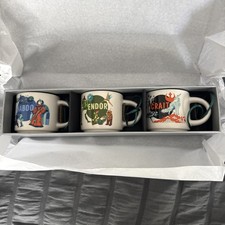
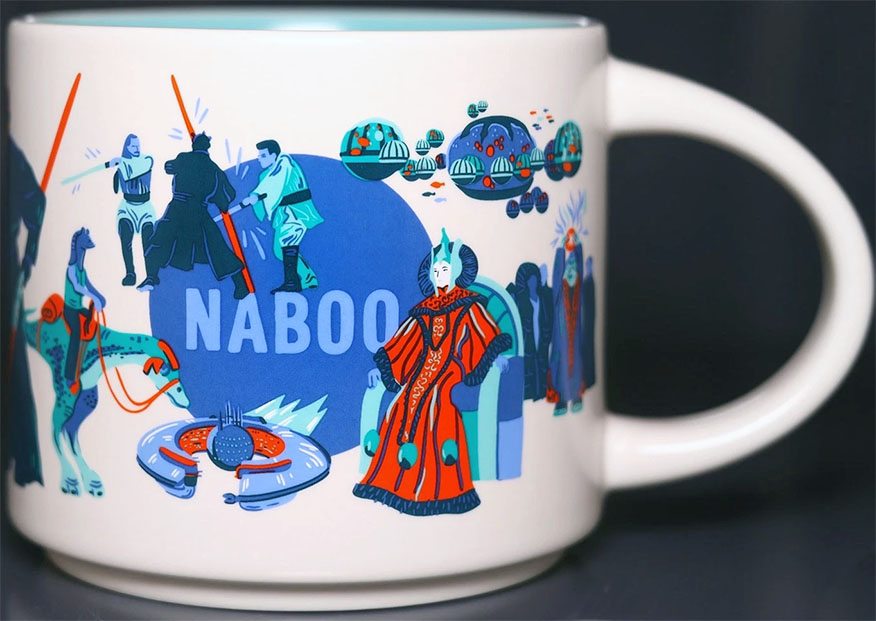
I completely forgot to add the third Star Wars mug that was released this past May. The Starbucks Discovery Series Naboo is a mug for one of the most elegant and culturally rich worlds in the Star Wars galaxy. Known for its rolling green landscapes, grand cities, and peaceful lakes, the planet served as the homeworld of Padmé Amidala, Emperor Palpatine, and the Gungan civilization. Introduced in The Phantom Menace, Naboo became the setting for some of the saga’s most important political and personal storylines. The mug design brings together several of the planet’s most recognizable landmarks, characters, and moments from the films.
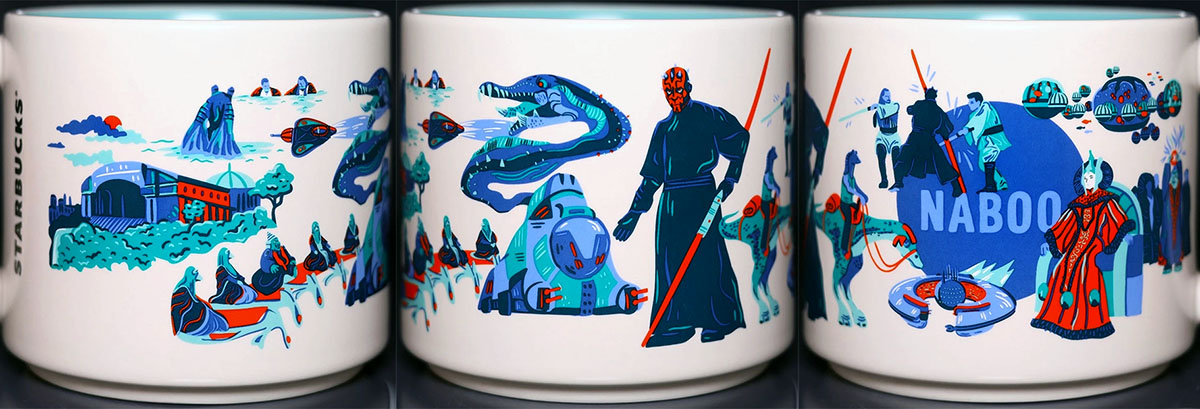
– Theed Royal Palace is represented by the grand domed building featured on the left side of the design. Overlooking the capital city of Theed, the palace served as the seat of Naboo’s monarchy and was home to Queen Amidala during the events of The Phantom Menace. Its elegant architecture, inspired by European palaces and classical design, helped establish Naboo as one of the most visually distinctive worlds in Star Wars.
– The Gungan sacred place, marked by the towering stone statues rising from the water, reflects the deep spiritual traditions of Naboo’s indigenous inhabitants. These ancient monuments are seen during Qui-Gon Jinn and Obi-Wan Kenobi’s journey across the planet and serve as reminders of the long history shared by the Gungans and the people of Naboo.
– Darth Maul stands at the center of the mug as one of the most memorable villains in the saga. Armed with his double-bladed lightsaber, the Sith apprentice arrived on Naboo to carry out Darth Sidious’s plans and ultimately confronted Qui-Gon Jinn and Obi-Wan Kenobi. His appearance in The Phantom Menace left a lasting impression and produced one of the franchise’s most celebrated lightsaber duels.
– The Battle of the Heroes on Naboo is represented by the duel between Darth Maul, Qui-Gon Jinn, and Obi-Wan Kenobi. Fought within the Theed power generator complex, the confrontation ended with the death of Qui-Gon Jinn and the apparent defeat of Maul. The battle remains one of the defining moments of the prequel trilogy and changed the course of galactic history.
– Padmé Amidala appears in her ceremonial royal attire near the city name. As Queen of Naboo, she played a pivotal role in resisting the Trade Federation invasion and later became one of the Republic’s most influential senators. Her leadership, courage, and diplomacy made her one of the most important figures associated with the planet.
– The Gungan bongo submarine can be seen near the lower edge of the design. These unusual underwater vessels were used to travel through Naboo’s vast network of lakes and underwater passages. Protected by energy fields and capable of navigating waters inhabited by dangerous sea creatures, the bongos played a memorable role in The Phantom Menace.
– Otoh Gunga, the underwater city of the Gungans, is represented by the collection of bubble-like domes floating above the Naboo name. Hidden beneath the waters of Lake Paonga, the city featured organic architecture enclosed within large energy shields. It remains one of the most unique and visually striking settlements ever seen in the Star Wars universe.
– The Fambaas, the large creatures shown near the duel scene, were used by the Gungans during the Battle of Naboo. These massive animals carried shield generators that protected Gungan forces from the advancing droid army. Their presence highlights the important role that native wildlife played in Naboo’s defence.
– The Naboo sea creatures featured throughout the design are a nod to the planet’s dangerous underwater ecosystem. During their journey to Otoh Gunga, Qui-Gon, Obi-Wan, and Jar Jar encountered enormous predators lurking beneath the surface. The sequence famously gave rise to Qui-Gon’s observation that “there’s always a bigger fish,” a line that has become part of Star Wars lore.