Discovery Series – Alabama


Let’s review the Discovery Series Alabama mug from “the Yellowhammer State”.
Alabama’s history as the “Heart of Dixie” begins with its admission to the Union as the 22nd state on December 14, 1819. The state played a pivotal role in American history, serving as the birthplace of the Confederacy when Montgomery became its first capital in 1861. During the Civil Rights Movement of the 1950s and 1960s, Alabama became the stage for transformative events, including the Montgomery Bus Boycott in 1955 and the Selma to Montgomery marches in 1965. From its cotton plantation economy to modern aerospace and automotive manufacturing, Alabama has evolved while maintaining deep connections to Southern traditions, college football passion, and musical heritage that gave birth to influential sounds from blues and jazz to country and rock.
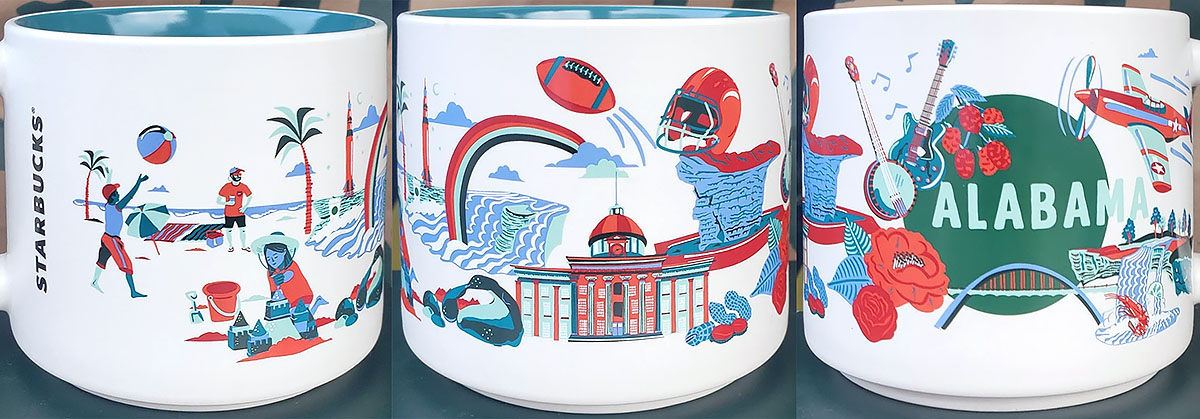
– College football is the beating heart of Alabama culture, with the state’s fierce rivalry between the University of Alabama Crimson Tide and Auburn University Tigers defining fall weekends. Alabama football has produced legendary coaches, such as Bear Bryant and Nick Saban, along with numerous national championships that make the sport a year-round obsession. Game days transform into sacred rituals where communities unite, stadiums overflow with passionate fans, and the phrase “Roll Tide” or “War Eagle” serves as both greeting and identity.
– The Alabama State Capitol in Montgomery stands as a National Historic Landmark where Jefferson Davis was inaugurated as Confederate President in 1861. This Greek Revival building also marks the endpoint of the 1965 Selma to Montgomery voting rights march, where Dr. Martin Luther King Jr. delivered his “How Long, Not Long” speech. The Capitol represents Alabama’s complex history, serving as a witness to both the struggle for civil rights and the ongoing journey toward equality.
– The beaches of the Gulf Coast showcase Alabama’s 60 miles of white sand coastline along the Gulf of Mexico, centred around Gulf Shores and Orange Beach. These pristine beaches with their sugar-white sand and turquoise waters offer a tropical paradise that contrasts with Alabama’s inland landscapes. The Gulf Coast represents Alabama’s diverse geography and its role as a beloved vacation destination drawing millions of visitors annually.
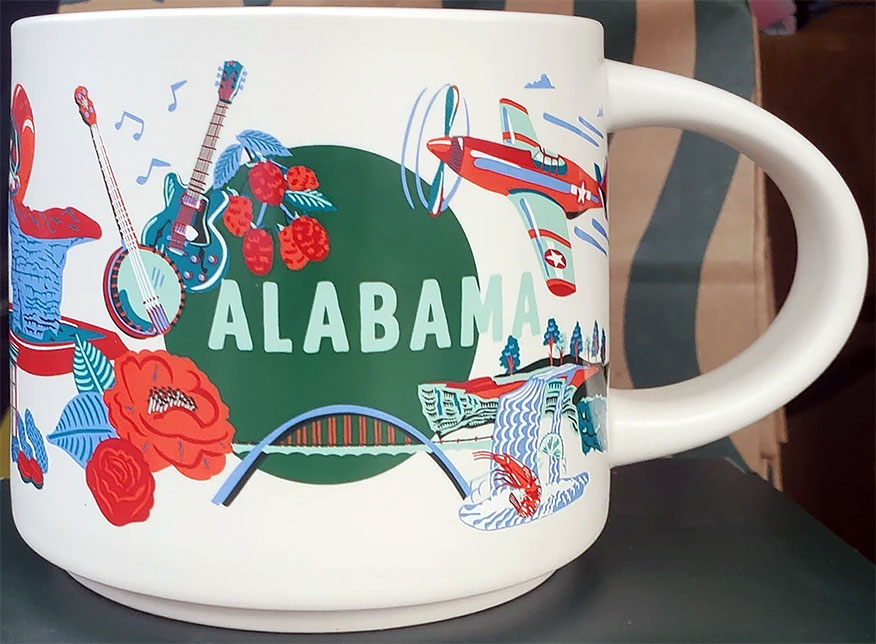
– Music and guitars celebrate Alabama’s profound influence on American music, from the blues of W.C. Handy to the soul of Muscle Shoals Sound Studio. The legendary FAME Studios and Muscle Shoals Sound attracted icons like Aretha Franklin, The Rolling Stones, and Wilson Pickett, creating timeless recordings. Alabama’s musical heritage spans genres and generations, cementing the state’s reputation as hallowed ground for American popular music.
– The camellia flower is Alabama’s official state flower, symbolizing Southern beauty and grace with its delicate blooms. These elegant flowers thrive in Alabama’s climate and have been cultivated in the state since the 1840s. The camellia represents the genteel traditions of the Old South while adorning gardens throughout Alabama with vibrant colours from winter through spring.
– The Edmund Pettus Bridge in Selma stands as one of America’s most significant civil rights landmarks, where peaceful marchers were brutally attacked on “Bloody Sunday” in 1965. This steel arch bridge became a symbol of courage and the struggle for voting rights, ultimately leading to the passage of the Voting Rights Act. The bridge represents Alabama’s central role in the Civil Rights Movement and the ongoing fight for justice and equality.
– NASA and space exploration highlight Alabama’s role in America’s journey to the moon through the U.S. Space & Rocket Center in Huntsville. The Marshall Space Flight Center developed the Saturn V rocket that carried astronauts to the moon under the leadership of Wernher von Braun. Huntsville’s transformation into “Rocket City” represents Alabama’s contributions to science, technology, and aerospace innovation.
– The blackberry is Alabama’s official state berry, growing wild throughout the state’s forests, roadsides, and fields. These sweet-tart berries ripen in late spring and early summer, providing free harvests for generations of Alabamians who turn them into pies, jams, and cobblers. The blackberry represents Alabama’s agricultural bounty and the connection between the land and traditional Southern foodways that continue to shape the state’s culinary identity.