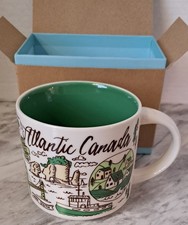

Discovery Series Ornament – Atlantic Canada


Similar to the previous collection, Starbucks released a single mug for the Atlantic Canada region rather than separate designs for each province. This approach added some challenges for designers, as they had to create a one-size-fits-all design for the Discovery Series Ornament Atlantic Canada.
Atlantic Canada refers to the region of Eastern Canada comprising four provinces: New Brunswick, Newfoundland and Labrador, Nova Scotia, and Prince Edward Island. The term “Atlantic Canada” was coined by Joey Smallwood, the first premier of Newfoundland, when the Dominion of Newfoundland joined Canada in 1949. He created this designation to distinguish the region from the existing term “Maritime provinces,” which traditionally referred only to New Brunswick, Prince Edward Island, and Nova Scotia. The region is distinguished by its position along the Atlantic coast, its rugged natural beauty, and its deep maritime heritage. These provinces historically were home to the Mi’kmaq, Naskapi, Beothuk, and Nunatsiavut peoples. The term has since become widely used to describe this culturally and geographically distinct corner of Canada, where the land dramatically meets the sea.
– While maple syrup production is most famously associated with Quebec and Ontario, pancakes served with maple syrup represent a beloved Canadian breakfast tradition that extends throughout Atlantic Canada. Saint-Quentin, known as the “Maple Capital” of Atlantic Canada, hosts the Canadian Maple Festival each year, celebrating the region’s maple syrup industry. The combination of fluffy pancakes drizzled with golden maple syrup embodies Canadian hospitality and comfort food culture.
– Atlantic Canada has earned an international reputation for its exceptional seafood, particularly lobster. Over half the world’s supply of North Atlantic lobster comes from the pure and icy waters of Canada’s Atlantic Ocean. The region’s coastal communities have built their identities around fishing, with lobster, cod, scallops, and mussels forming the backbone of both the economy and the cuisine. Seafood chowder is a regional delicacy found across Atlantic Canada, with recipes varying from family to family and restaurant to restaurant. From dockside lobster pounds where diners can select their own catch to elegant restaurants serving sophisticated seafood preparations, Atlantic Canada offers an unmatched culinary experience centered on the bounty of the North Atlantic.
– The Jellybean Row Houses of downtown St. John’s have made the city rank as the most colourful city in Canada. These vibrantly painted Victorian row houses create a whimsical streetscape that delights visitors and photographers alike. Most of downtown St. John’s burned in the Great Fire of 1892, and the houses were rebuilt in 1893 during the Victorian era. The bright colors weren’t traditional—the practice began in the late 1970s when a local heritage group renovated houses on Gower Street and painted them in bright colors as a way to inject new life into a declining downtown. The concept caught on with residents, and the palette spread throughout the historic downtown, transforming St. John’s into one of North America’s most visually striking cities and creating an iconic symbol of Newfoundland and Labrador.
– Lighthouses stand as enduring symbols of Atlantic Canada’s maritime heritage, dotting the rugged coastlines as silent sentinels of the sea. With 150 lighthouses in Nova Scotia alone, it’s challenging to journey through Atlantic Canada without seeing at least one. The Cape Spear Lighthouse near St. John’s has been flashing since the mid-19th century as an iconic symbol of the province’s mariner history and is the oldest surviving light in Newfoundland and Labrador. These structures historically served as beacons to sailors navigating treacherous waters, marking dangerous coastlines and guiding ships to safe harbor.
– Atlantic Canada has emerged as an unexpected world-class golf destination, featuring some of Canada’s most spectacular courses. The region boasts bucket-list golf courses, including Cabot Cliffs and Cabot Links, ranked #1 and #5 courses in Canada, respectively, according to SCOREGolf in 2022. Located along the coast of Cape Breton, Nova Scotia, Cabot Cape Breton features 47 spectacular holes and offers a rare chance to experience golf as it was meant to be played: on firm, sandy turf, with the ocean breeze shaping every shot.