Discovery Series – Santa Cruz de la Sierra


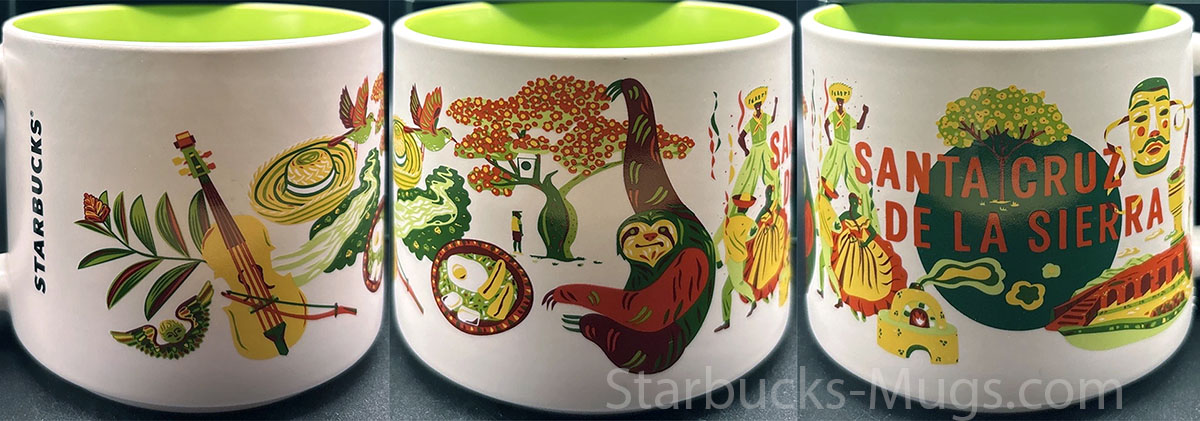
The Starbucks Discovery Series Santa Cruz de la Sierra mug takes us to Bolivia’s largest city and the center of the country’s tropical eastern lowlands. Santa Cruz de la Sierra was founded by Ñuflo de Chaves in 1561, although the settlement was later moved several times before becoming established at its present location. Over the centuries, the city developed very differently from Bolivia’s high-altitude Andean centers, with strong influences from the Indigenous cultures of the eastern lowlands. Today, Santa Cruz is one of Bolivia’s main economic centers while retaining a distinctive regional culture known as camba.
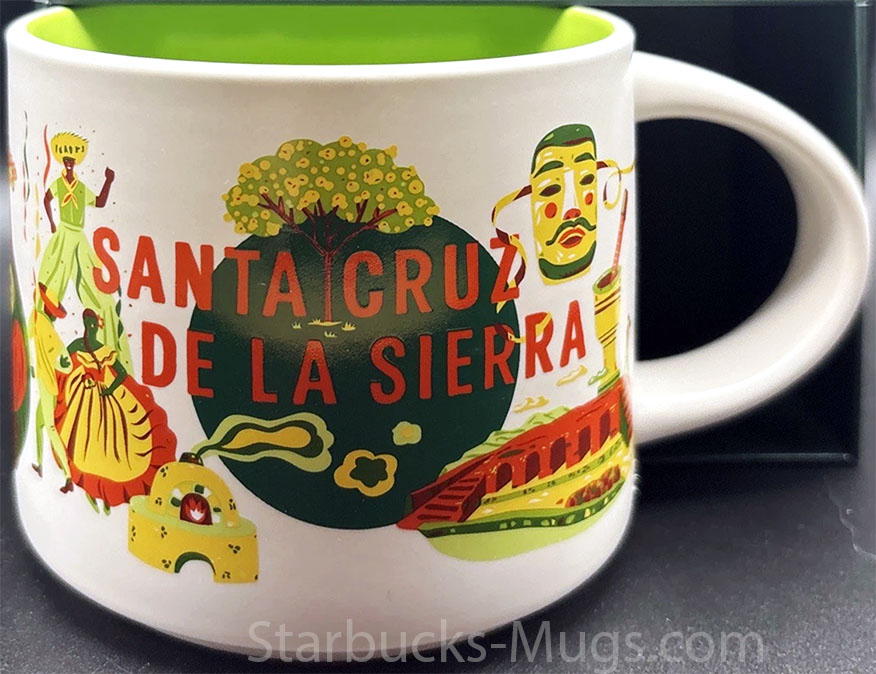
– The colorful figures in traditional clothing represent the traditional dances of Santa Cruz. The region has several characteristic dances, including the taquirari, chovena, carnavalito cruceño, brincao, and sarao. Colorful costumes and lively music remain particularly visible during festivals and celebrations throughout Santa Cruz.
– The broad-flowering tajibo tree is one of the characteristic trees of Santa Cruz. Different species produce spectacular pink, yellow, or white blossoms, often covering much of the crown when the trees flower. The tajibo is considered a floral symbol of Santa Cruz and an important part of the region’s natural landscape.
– The Mask of the Chiquitano Grandfather of San José refers to the cultural traditions of San José de Chiquitos in the Santa Cruz Department. Known locally as the Abuelo Chiquitano, this distinctive character appears in traditional celebrations wearing a carved mask with exaggerated facial features. It is part of the cultural heritage of the Chiquitano people and remains closely associated with the festivities and identity of San José de Chiquitos.
– The tatacua is a traditional clay or brick oven commonly found in eastern Bolivia. Similar to a wood-fired oven, it is used for baking a variety of regional foods, including breads, pastries, and meat dishes. Tatacuas remain particularly associated with traditional cooking in Santa Cruz and the wider Bolivian lowlands.
– The toborochi tree (Ceiba speciosa) is another distinctive tree commonly associated with Santa Cruz. It is easily recognized by its swollen, bottle-shaped trunk, which is often covered with large conical thorns, and by its beautiful pink flowers. Toborochis are a familiar sight throughout the city and are also connected with Indigenous legends explaining the tree’s unusual shape.
– The large sloth reflects the wildlife of Bolivia’s tropical lowlands. Santa Cruz Department contains an extraordinary variety of habitats, ranging from Amazonian forests and wetlands to the Chiquitano dry forest and Gran Chaco. Sloths inhabit forested areas of eastern Bolivia and are among the distinctive animals found in this part of the country.
– Majadito is one of the dishes most closely associated with Santa Cruz and eastern Bolivia. It is based on rice traditionally prepared with charque, or dried meat, and is commonly served with fried egg and plantain, with yuca often accompanying the meal. Different versions can also be prepared with chicken, duck, or other meats.
– The sombrero de sao is a traditional hat strongly associated with Santa Cruz and the culture of Bolivia’s eastern lowlands. It is handwoven from the leaves of the sao palm, producing a lightweight hat particularly well suited to the region’s hot climate. Over time, it has become one of the most recognizable symbols of camba identity and is commonly worn during traditional celebrations.
– The Violin Village of Urubichá reflects the remarkable musical tradition of this small town in the Santa Cruz Department. Urubichá is particularly famous for its musicians and for preserving the tradition of making violins by hand, a craft with roots in the musical culture introduced during the colonial period. Music remains an important part of community life, and the town has become closely associated with the preservation and teaching of Baroque and Indigenous musical traditions.