Discovery Series Ornament – Bolivia


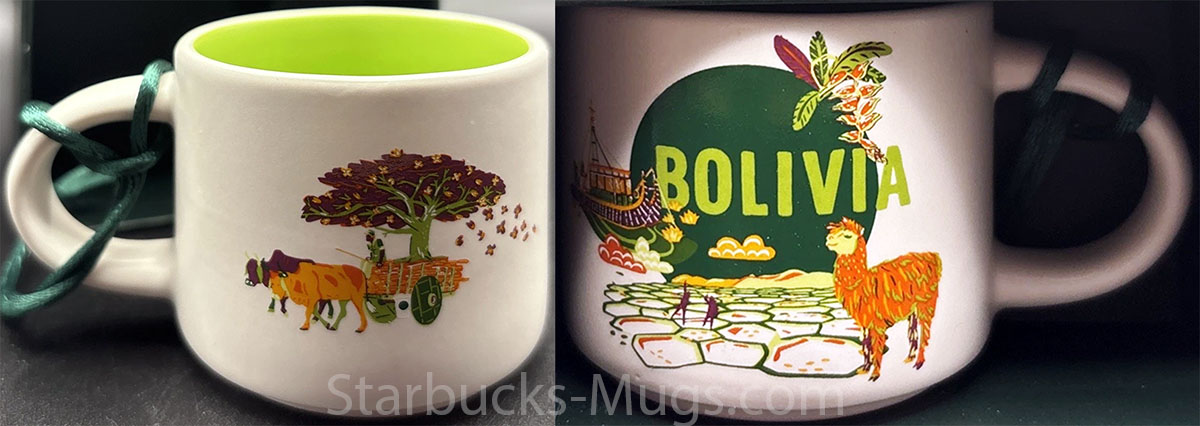
The Starbucks Discovery Series Ornament Bolivia showcases some of the country’s best-known natural and cultural symbols in the smaller ornament format. Bolivia became an independent republic in 1825 and takes its name from Simón Bolívar. Its geography is remarkably varied, stretching from the high Andes and Altiplano to valleys, tropical lowlands, and the Amazon basin. This diversity is reflected especially well in the ornament’s combination of high-altitude scenery and tropical plants.
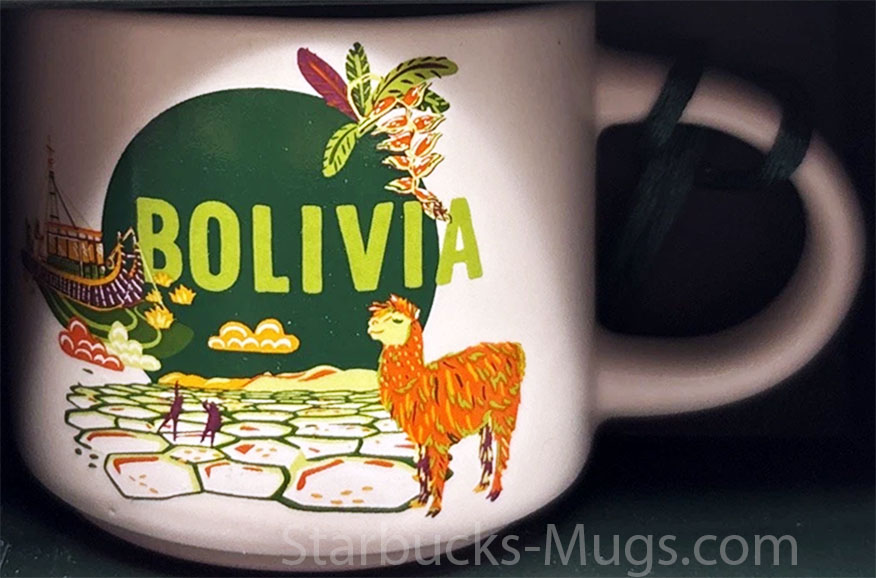
– The llama is one of the animals most closely associated with Bolivia and the Andes. Domesticated for thousands of years, llamas have traditionally been used as pack animals and valued for their wool by communities living at high elevations. Their ability to thrive in the thin air and harsh conditions of the Altiplano makes them a familiar sight throughout western Bolivia.
– The Salar de Uyuni is the world’s largest salt flat, covering more than 4,000 square miles in southwestern Bolivia. It was formed by the transformation and evaporation of prehistoric lakes that once covered the region. During the rainy season, a shallow layer of water can transform its vast white surface into an enormous natural mirror.
– Bolivia has two official national flowers: the Kantuta (Cantua buxifolia) and the Patujú (Heliconia rostrata). The Kantuta is particularly associated with the Andean regions, while the Patujú is native to the country’s tropical lowlands. Together, the two flowers reflect Bolivia’s remarkably different geographic regions and are officially recognized as national symbols.
– Lake Titicaca, shared by Bolivia and Peru, lies high in the Andes at an elevation of about 12,500 feet (3,810 meters). Traditional boats made from bundles of totora reeds have been used on the lake for generations, particularly for fishing and transportation. The distinctive reed boats remain closely associated with the indigenous communities living around Titicaca.
– The Delonix regia, commonly known as the royal poinciana or flamboyant tree, is recognizable by its broad spreading crown and brilliant red-orange flowers. Native to Madagascar, the species was introduced to tropical and subtropical regions around the world and is now grown as an ornamental tree in Bolivia as well.
– The traditional ox cart reflects the agricultural life of Bolivia’s rural communities. Pairs of oxen have long been used to pull wooden carts for transporting crops, supplies, and other heavy loads, as well as to help with work in the fields. Although modern vehicles and machinery have largely replaced them in many areas, ox-drawn carts can still be associated with traditional farming practices in the Bolivian countryside.