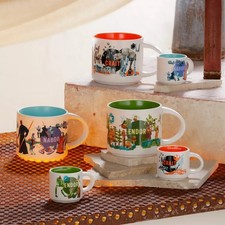

Discovery Series Ornament – Naboo


Starbucks Discovery Series Ornament Naboo is an ornament for a peaceful and culturally rich planet in the Star Wars universe, prominently featured in Star Wars: The Phantom Menace and later films in the saga. Known for its rolling green landscapes, classical architecture, and elegant cities, Naboo stands in contrast to many of the harsher worlds in the galaxy. It is home to both the human population and the Gungan civilization, each with its own distinct way of life. The planet plays a central role in galactic politics and is closely tied to key characters such as Padmé Amidala and Emperor Palpatine.
The design highlights several recognizable elements from Naboo, capturing its beauty, culture, and pivotal moments from the films.
– Theed Royal Palace serves as one of Naboo’s most important landmarks. Located in the capital city of Theed, the palace features grand domes, ornate halls, and elevated terraces overlooking the surrounding landscape. It is the seat of Naboo’s monarchy and a key setting for political events throughout the films.
– Queen Amidala is depicted in her iconic royal attire. Her elaborate robes and detailed headdress represent the formal traditions of Naboo’s monarchy. The striking red costume stands out as one of the most memorable visual elements from the prequel trilogy.
– Darth Maul’s duel is referenced through the lightsaber battle scene. The confrontation between Darth Maul, Qui-Gon Jinn, and Obi-Wan Kenobi is one of the defining moments of The Phantom Menace. The crossed lightsabers symbolize the intensity and significance of that encounter.
– Otoh Gunga represents the underwater city of the Gungans. Built beneath the surface of Naboo’s lakes, the city is composed of large, glowing bubble-like structures connected by tunnels. Its organic design contrasts sharply with the classical architecture found in Theed.
– Gungan rider on a fambaa appears on the front of the mug. The large creature, used by the Gungans in battle, is shown with a rider guiding it across the landscape. This detail references the ground battle scenes and highlights the presence of Naboo’s native inhabitants.