Discovery Series – Ciudad de Mexico


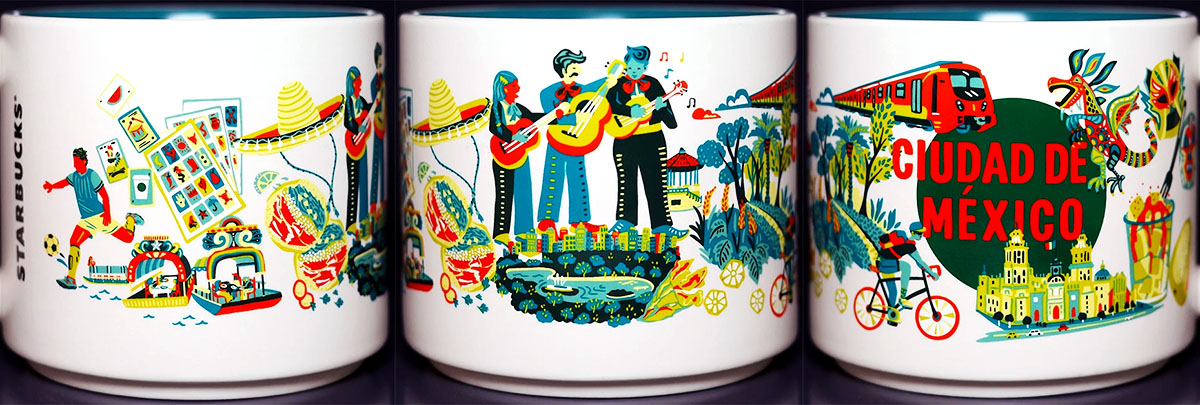
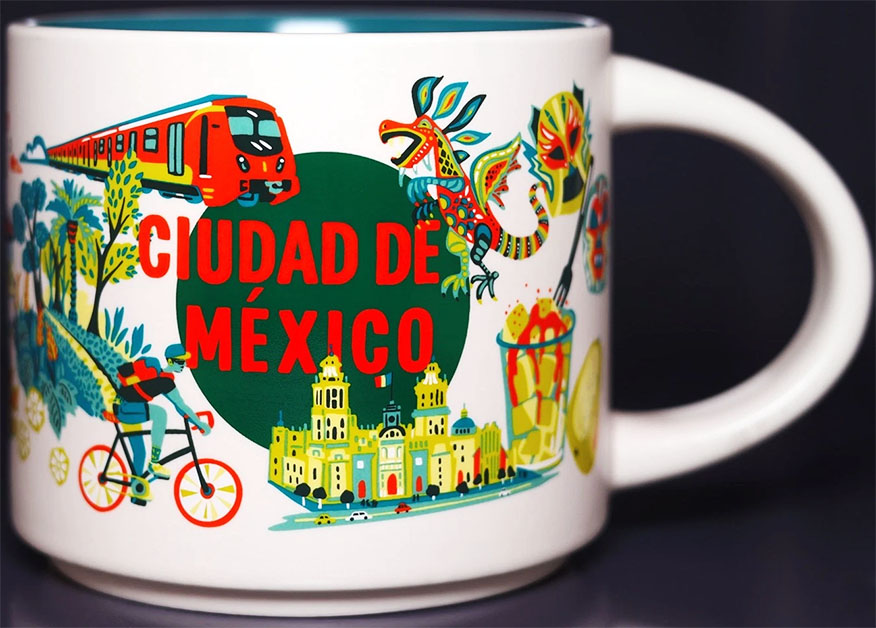
The Starbucks Discovery Series Ciudad de México mug takes us to Mexico City, one of the largest and oldest capitals in the Americas. The modern city stands on the site of Tenochtitlan, the Aztec capital founded in the 14th century on islands in Lake Texcoco. After the Spanish conquest in 1521, Mexico City became the capital of New Spain and later, following Mexican independence, the capital of the new nation. Today, its Indigenous and colonial heritage exists alongside an enormous modern metropolis, something reflected particularly well in this colorful design. Starbucks itself identifies the Metro, Metropolitan Cathedral, Xochimilco, Chapultepec, and lucha libre among the main references used for this release.
– The red Mexico City Metro train is an appropriate symbol for a city where the subway is such an important part of everyday life. The system opened in 1969 and has since expanded to 12 lines and 195 stations. Its distinctive station symbols were originally developed so that destinations could be easily recognized even without reading their names.
– The colorful alebrijes add some of Mexico’s fantastic creatures to the design. These brightly decorated sculptures combine features of different real and imaginary animals, often resulting in dragons, birds, reptiles, and other unusual creatures. Mexico City has a particularly visible connection to the tradition through its annual Monumental Alebrijes Parade.
– The Metropolitan Cathedral overlooks the Zócalo in the historic center and is one of Mexico City’s most important colonial landmarks. Construction began in the 16th century and continued for roughly 250 years, resulting in a building incorporating several architectural styles. It stands close to the remains of the Aztec Templo Mayor, emphasizing the different historical layers found in the center of the city.
– Cycling has become an increasingly familiar part of life in Mexico City, supported by an expanding network of bicycle lanes and the city’s Ecobici bike-sharing system. The weekly Muévete en Bici program also closes major streets to motor vehicles, allowing cyclists and pedestrians to take over some of the capital’s normally busy avenues.
– Chapultepec is one of Mexico City’s largest and most important green spaces. The enormous urban park contains forests, lakes, museums, cultural attractions, and Chapultepec Castle, which occupies a hill with a history stretching back to pre-Hispanic times. Starbucks specifically lists Chapultepec among the icons selected for this mug.
– The colorful boats are trajineras, the traditional flat-bottomed boats associated with Xochimilco. Visitors travel through the surviving canals aboard brightly painted boats, often accompanied by food vendors and musicians. The canals preserve part of the ancient network of waterways and agricultural islands that once characterized the Valley of Mexico, making Xochimilco an important link with the city’s pre-Hispanic past.
– The masked figure refers to lucha libre, Mexico’s famously theatrical form of professional wrestling. Colorful masks, acrobatic moves, dramatic rivalries, and larger-than-life characters have made lucha libre an important part of Mexican popular culture. Mexico City’s Arena México, opened in 1956, is one of the sport’s most famous venues.
– The illustrated cards represent lotería, a traditional Mexican game somewhat similar to bingo. Instead of numbered balls, the game uses a deck of illustrated cards depicting familiar characters and objects, while players mark the corresponding pictures on their boards. Its instantly recognizable imagery has become part of Mexican popular culture far beyond the game itself.
– Football is another major part of life in the Mexican capital. Mexico City is home to several professional clubs and to the enormous Estadio Azteca, one of the world’s best-known football stadiums. The venue has hosted some of the most important matches in the history of the sport.
– Finally, the three mariachi musicians reflect a musical tradition heard throughout Mexico City, particularly around Plaza Garibaldi. Groups of musicians gather there in traditional charro-style clothing and can be hired to perform songs for visitors and celebrations. Although mariachi originated in western Mexico rather than the capital, Garibaldi has made the music an unmistakable part of Mexico City’s cultural life.