Discovery Series – Fukuoka


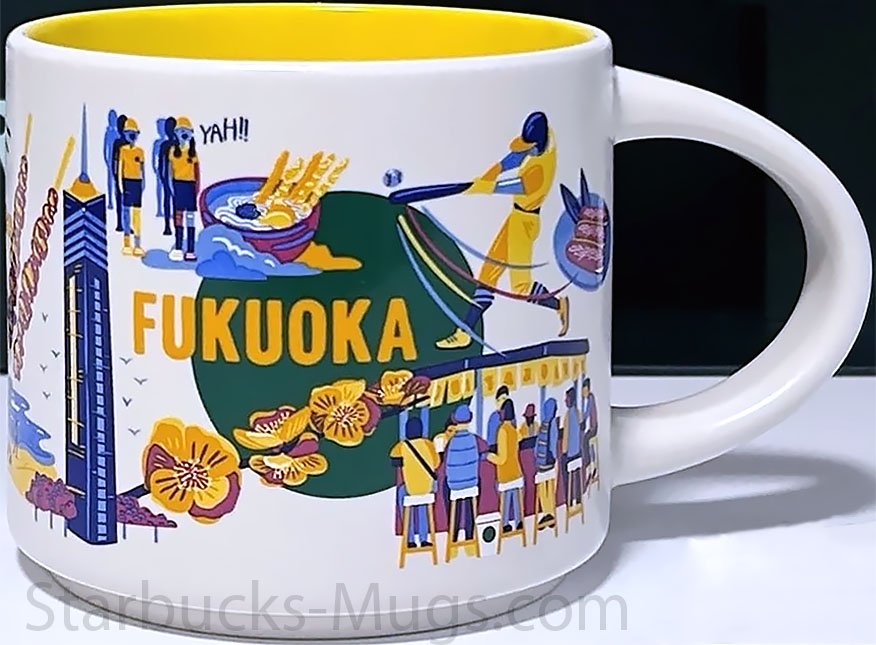
The Starbucks Discovery Series Fukuoka mug paints a lively picture of the northern gateway to Kyushu, mixing famous foods, traditional culture, modern landmarks, and seaside activities. Fukuoka developed around two neighboring centers: the merchant port of Hakata and the castle town of Fukuoka, which were formally joined into one city in 1889. Its long history as a trading port helped give the region an outward-looking character, while today it is equally famous for food stalls, ramen, festivals, beaches, and a relaxed lifestyle beside Hakata Bay.
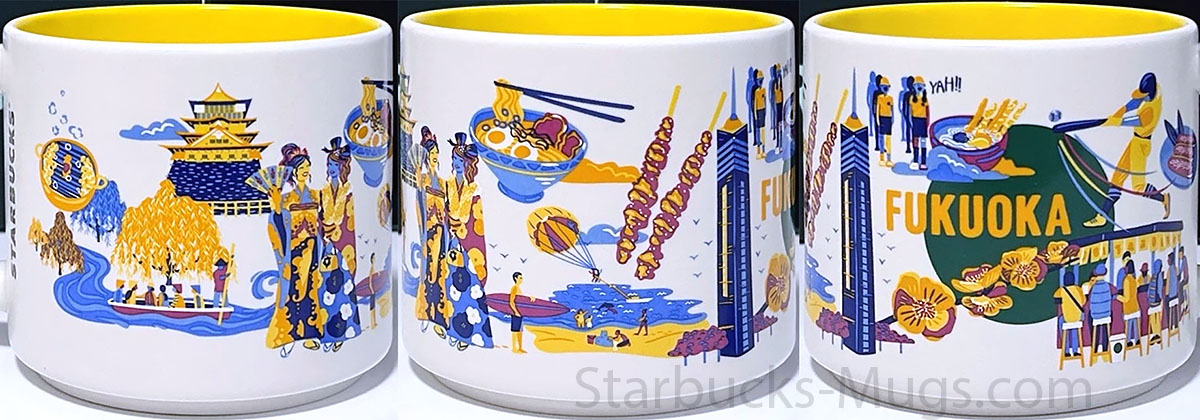
Here are some of the landmarks, foods, traditions, and activities featured in the design:
– The tall blue structure is Fukuoka Tower, one of the most recognizable features of the city’s modern waterfront. Rising 768 feet (234 meters), the triangular tower is covered with thousands of mirrored panels and stands near the beaches of the Momochi area. Its observation levels provide broad views across Fukuoka, Hakata Bay, and the surrounding coastline.
– The bowl of Hakata tonkotsu ramen represents perhaps Fukuoka’s most famous contribution to Japanese food culture. Thin noodles are served in a rich, milky broth created by simmering pork bones for many hours, usually with toppings such as sliced pork, green onions, and egg. The city is also known for the kaedama tradition, allowing diners to order an extra serving of noodles for the remaining broth.
– The skewers are yakitori, another food strongly connected with everyday dining in Fukuoka. Local yakitori restaurants grill not only chicken but also pork, vegetables, seafood, and other ingredients over an open flame. A particularly Fukuoka-style touch is the pile of seasoned cabbage commonly served before the skewers arrive, making the experience slightly different from yakitori elsewhere in Japan.
– The people sitting around the counter refer to Fukuoka’s famous yatai culture. These small open-air food stalls appear in areas such as Nakasu, Tenjin, and Nagahama after sunset, serving ramen, yakitori, oden, dumplings, and countless other dishes. With only a handful of seats at many stalls, customers often end up talking with the owner and the people sitting beside them, making yatai as much a social experience as a place to eat.
– The castle on the opposite side appears to be Kokura Castle in Kitakyushu, bringing a reference from elsewhere in Fukuoka Prefecture into the design. Originally constructed in the early 17th century, the castle has been rebuilt over time and today stands above its stone walls beside the surrounding gardens and river. Its inclusion shows that this mug reaches beyond Fukuoka City itself to represent the wider prefecture.
– The women dressed in elaborate kimono recall the tradition of the Hakata geigi. Fukuoka has maintained its own geisha culture since the Edo period, with performers trained in Japanese dance, music, singing, and traditional entertainment. Hakata geigi still appear at cultural performances and major local celebrations, preserving a refined side of the city’s heritage that contrasts nicely with the casual food and beach scenes elsewhere on the mug.
– The boat gliding beneath the trees refers to Yanagawa river cruising, one of the best-known experiences in southern Fukuoka Prefecture. Traditional flat-bottomed boats travel slowly through a network of canals while a boatman guides the vessel with a long pole, often singing local songs along the way. Seasonal flowers, old streets, and willow-lined waterways give Yanagawa an atmosphere quite different from the busy streets of central Fukuoka.
– The beach scene with the parachute represents seaside recreation and parasailing. Fukuoka’s position on Hakata Bay gives the city unusually easy access to beaches and water activities for such a large urban center. Swimming, sailing, paddle sports, and other activities become especially popular during the warmer months, while the coastline also provides a scenic escape only a short distance from downtown.
– The group shouting “Yah!” is one of the more unusual and very local details in the design. This energetic call is associated with a distinctive response culture familiar to people in Fukuoka, and Starbucks deliberately included it as an example of the small everyday habits that locals immediately recognize. It is exactly the kind of detail that makes the Discovery Series feel more personal than a design made entirely from famous tourist landmarks.