Discovery Series – Nara


The Starbucks Discovery Series Nara mug takes us to one of Japan’s most historically important places. Nara became the country’s first permanent capital in 710, beginning the Nara Period, when Buddhism, art, and architecture flourished under imperial patronage. Although the capital later moved away, Nara preserved an extraordinary concentration of ancient temples, shrines, sacred forests, and traditional culture. Today, the city is perhaps best known for the deer roaming freely around Nara Park and the enormous Great Buddha of Tōdaiji.
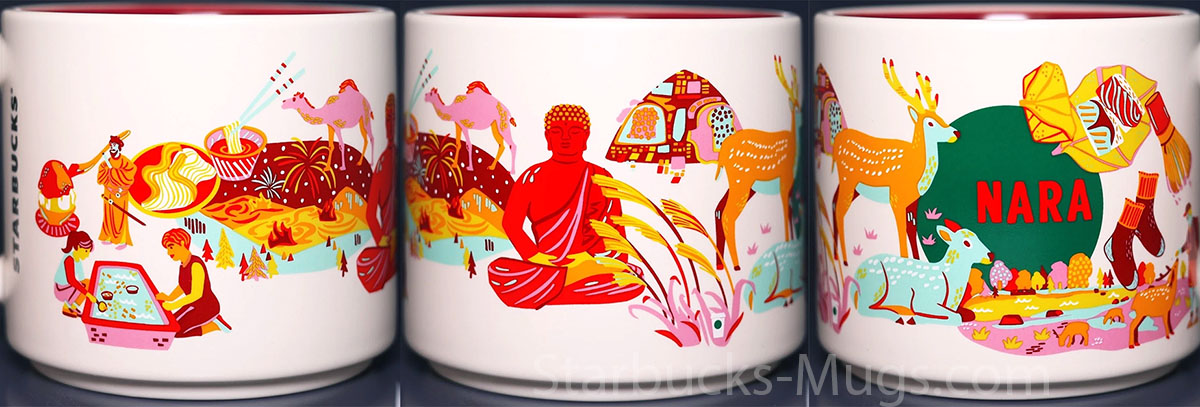
Here are some of the landmarks, foods, traditions, and symbols featured in the design:
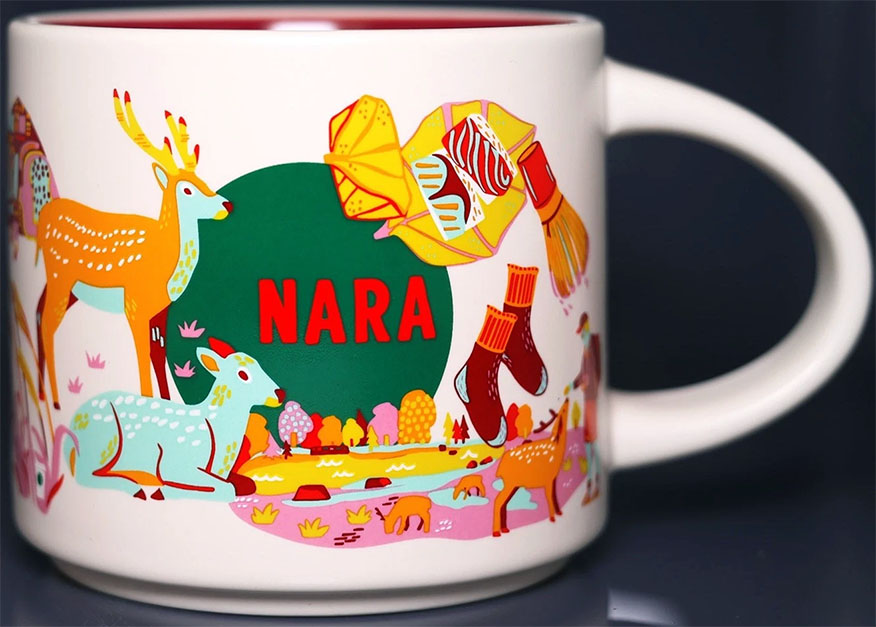
– The deer of Nara Park are probably the city’s most recognizable symbol, and naturally they appear several times across the mug. Around 1,400 wild sika deer live in and around the park, where they have been protected for centuries. According to local tradition, deer became associated with Kasuga Taisha after a deity was believed to have arrived in Nara riding a white deer, which led to their reputation as sacred messengers of the gods.
– The seated figure is the Great Buddha of Tōdaiji, one of Nara’s most important landmarks. Completed in the 8th century, the bronze Vairocana Buddha stands about 49 feet (15 meters) tall inside the Great Buddha Hall. Tōdaiji became one of the leading Buddhist temples of ancient Japan and remains one of the first places many visitors associate with Nara.
– The mountain scene appears to reference Mount Wakakusa, the grass-covered hill rising just beyond Nara Park. The mountain offers wide views over the city and is especially famous for the annual Wakakusa Yamayaki, when the hillside is deliberately set ablaze during a spectacular winter event accompanied by fireworks.
– The colorful wrapped food looks like kakinoha sushi, one of Nara Prefecture’s best-known specialties. Pieces of cured or cooked fish are placed over pressed sushi rice and wrapped in persimmon leaves, which historically helped preserve the food before refrigeration. The compact parcels are still widely sold throughout Nara as a traditional meal and souvenir.
– The bowl of fine noodles appears to be Miwa somen, a specialty with particularly deep roots in Nara. These extremely thin wheat noodles are associated with the Miwa area and are especially popular during the hot summer months, when they are commonly served chilled with a light dipping broth. Nara is considered one of the historic centers of somen production in Japan.
– The traditional clothing and decorative patterns reflect Nara’s long craft heritage. The city developed as an important center of Buddhist art and craftsmanship more than a thousand years ago, and traditional products such as brushes, textiles, lacquerware, and carved objects are still produced in the region today. Nara brushes in particular trace their history back roughly 1,200 years.
– The Silk Road reference appears through the camel on the back of the mug. Nara was the eastern end of cultural exchange routes that connected Japan with China, Central Asia, and regions even farther west, especially during the 8th century when the city served as the imperial capital. Goods, artistic styles, religious ideas, and technologies travelled along these networks and helped shape Nara’s cosmopolitan culture during its golden age.
– Yoshikien Garden is one of Nara’s peaceful traditional gardens, located close to Isuien and the grounds of Tōdaiji. It is divided into several areas, including a pond garden, moss garden, and tea ceremony garden, each offering a different style of landscape design. The garden is especially beautiful during the changing seasons, with fresh greenery in spring and vivid colors in autumn.