Discovery Series – Peru


The Starbucks Discovery Series Peru mug highlights a country shaped by ancient civilizations, dramatic Andean landscapes, distinctive wildlife, traditional crafts, music, and one of South America’s best-known cuisines. Peru was the heart of the Inca Empire before the Spanish conquest in the 16th century, but its history reaches much further back through cultures such as the Moche, Nazca, Wari, and Chavín. Today, the country’s identity combines Indigenous traditions, colonial influences, and enormous geographic diversity stretching from the Pacific coast to the Andes and Amazon rainforest.
Here are some of the landmarks, traditions, foods, and symbols featured in the design:
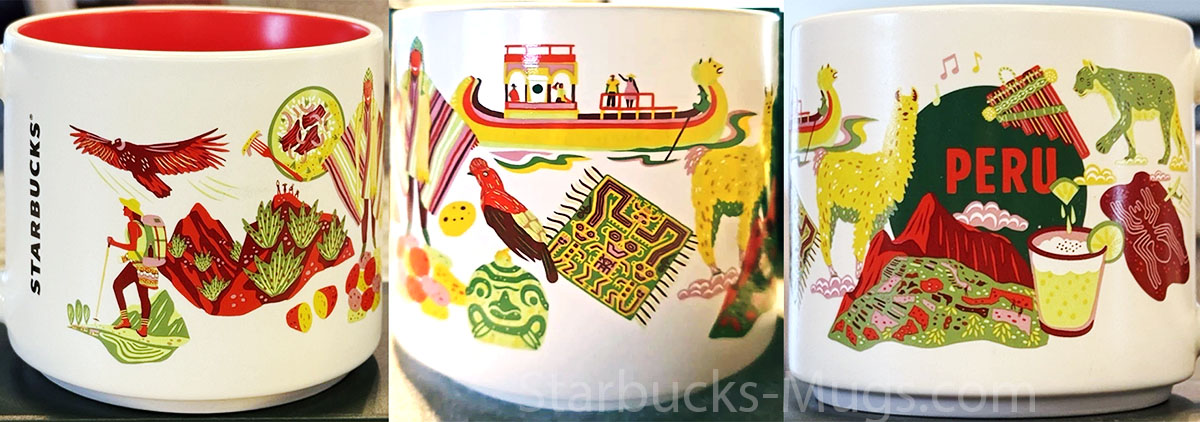
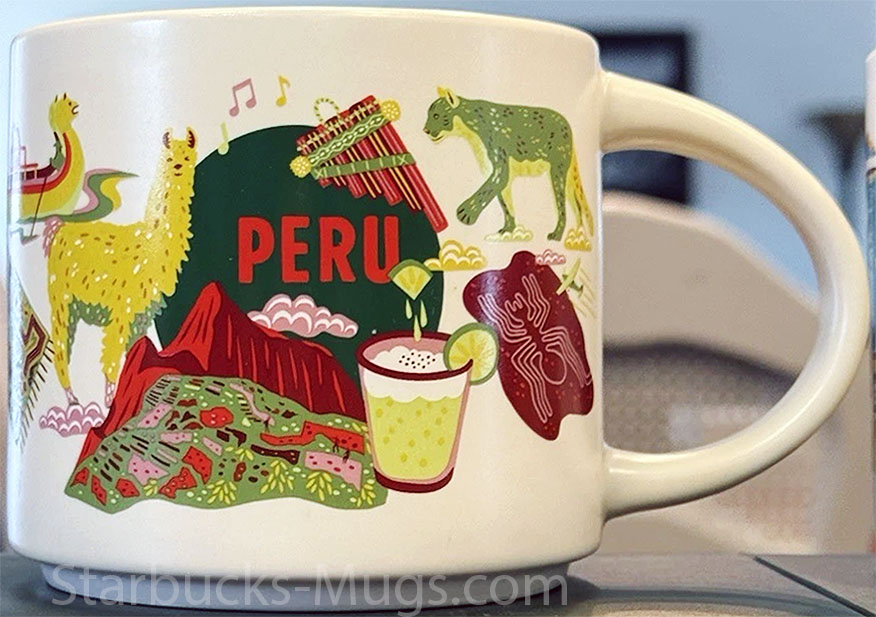
– Machu Picchu is easily the most recognizable landmark on the front of the mug. Built high in the Andes around the 15th century, the Inca citadel contains agricultural terraces, temples, residences, and precisely constructed stone buildings surrounded by steep mountains. Today, it is a UNESCO World Heritage Site and one of Peru’s most internationally recognized landmarks.
– The glass of Pisco Sour features the familiar pale drink topped with foam and served with lime. The cocktail combines pisco, lime juice, syrup, egg white, and bitters, and its documented history dates to Lima in the early 20th century. It has become one of Peru’s signature drinks and was declared part of the country’s cultural heritage in 2007.
– The large zampoña, or Andean pan flute, recalls the traditional music of Peru’s highlands. Made from rows of reed pipes of different lengths, the instrument has deep pre-Columbian roots and remains an important part of Andean folk music, often played together with drums, flutes, and string instruments.
– Jaguar is another striking symbol in the design. As the largest wild cat in the Americas, the jaguar is one of the most powerful animals found in Peru, especially in the Amazon rainforest. It has long held an important place in the mythology and visual culture of ancient civilizations in the region, where it was associated with strength and mystery.
– The llama is one of the animals most closely associated with the Peruvian Andes. Domesticated for thousands of years, llamas traditionally served as pack animals and provided wool for highland communities. They remain a familiar sight throughout the Andes and around major archaeological sites.
– The colorful Andean textile highlights Peru’s long tradition of weaving. Indigenous communities have produced intricately patterned textiles for centuries using alpaca, llama, and sheep wool, with colors and geometric designs often varying by region. Weaving remains an important craft in highland communities today.
– The red bird is the Andean cock-of-the-rock, widely considered Peru’s national bird. The male is especially distinctive, with brilliant orange-red plumage and a large rounded crest. It inhabits humid Andean forests and can be found in areas around Machu Picchu and Manu.
– The decorated reed boat recalls the traditional vessels used on Lake Titicaca. Communities around the lake have long constructed boats from totora reeds, using them for fishing and transportation. Modern ceremonial and tourist versions are often much more elaborate, with raised platforms and animal-shaped prows.
– The large Andean condor is one of the most impressive birds of the Andes. With a wingspan that can exceed 10 feet (3 meters), it can soar for long distances using mountain air currents. The condor also held great spiritual importance in pre-Columbian cultures and remains one of the iconic animals of Peru’s highlands.
– Hiking in the Andes is another natural addition to the design. Peru offers routes ranging from high-altitude mountain trails to the famous Inca Trail leading toward Machu Picchu. These hikes pass through valleys, mountain passes, archaeological sites, and rapidly changing ecosystems.
– The colorful potatoes point to one of Peru’s greatest contributions to world food. The Andes are the original home of the potato, and Peru still grows thousands of native varieties in an extraordinary range of colors, shapes, and textures. Potatoes remain a fundamental ingredient in Peruvian cooking, particularly in highland communities.